Thanks to some lucky timing, I'm currently in New York for a conference, having arrived on Saturday just in time to catch Gotham Girls Roller Derby (who some of you may have heard of ;) ) playing one of their Home Season bouts - regular season winners Queens of Pain playing other regular season winners Bronx Gridlock.
As with all situations where something familiar is embedded in something new, the experience was as interesting as to what was the same as to what was different. Despite their terrifying reputation, Gotham's home season bouts are hosted in College/University sports facilities, which are not particularly roomy; the venue at Hunter College has almost exactly enough width on the track for the track, the outside pack refs and one row of "VIP" seats on each side.
Being too cheap to spring for the VIP tickets, I simply turned up earlier and sat on the front row of the normal seating. This actually turns out to be generally better than the VIP seats, which are a bit too close to really take in the whole track at a glance, while the raised bleachers that host the generic seating give a better view. (For Glasgow, the Kelvinhall would actually provide a better justification for VIP trackside, since there's much more space for well positioned trackside locations, if you throw in some beanbags as London do).
The track was excellent, thanks to Gotham springing for the modular Skate Court surface tiles (which they then lay on whichever venue they're bouting at). I did appreciate the shocking pink tape used to lay out the track boundaries...
The bout itself was excellently reported, as always, by Gotham's in-house reporter,
Thomas Gerbasi: http://www.gothamgirlsrollerderby.com/news/1375/what-rebuilding-year-bronx-back-on-track-with-170-142-win-over-queens
After the bout, the after-party was also relatively amusing, although basically no different than the kind you get in the UK. Essentially, Gotham are, despite being the Number 1 team, also, of course, "just skaters" like the rest of the roller Derby community. And this is a good thing.

2012/05/12
Bout Report: ARRG Home Seasons Final: Double Header pt2
Part one of this report, covering the introduction, and the first bout (Cherry Bombers vs Glasgow Roller Derby's Hell's Belles) is here.
Facing each other for a second time, most people's money might have been on a Leithals victory; in their first match up, The Skatefast Club lost by a significant margin, 116 points to the Leithal Weapons' 209. Since then, however, Skatefast showed considerable improvement, fighting the Cherry Bombers for a hard-fought victory to get to this final. On that basis, this final was still anyone's to call.
 It was The Skatefast Club first off the mark as the bout started, Mo B Quick (66) fighting her way down the inside line just ahead of the Leithal's Admiral Attackbar (11:11), thanks to Mallory Powers' (9) blocking. With just enough of a lead to risk a score, Mo did so, picking up 2 points for the lemon team.
A power-jam for the Leithals in jam 3 helped Sharkée (273) break their duck, with Bint Imperial (893) off for a track cut major on her initial pass. A second scoring pass saw the Leithals jammer also off to the bin, however, for a back block on approach, handing the track back to Skatefast. Despite some tough walling from the blues, especially Alma Geddon (42), 2 scoring passes later the jam ended, with the power-jam still in place; just enough time for Blazin' Phoenix (28) to consolidate the Skatefast lead with another scoring pass in jam 4:
 Despite a tough rear wall holding Ciderella (3) back to allow Skatefasts' Mo B Quick (66) a good half track lead, both jammers scored in the next jam, the Leithals keeping to the front of the pack. A slightly too aggressive path through the scrum start in jam 6 saw Leithals star jammer Admiral Attackbar off to the penalty bench in the very next jam, however, handing Blazin' Phoenix her team's second power jam of the bout. Despite heavy resistance on her initial pass, being recycled far back by Sharkée, Blaze picked up a hard fought 12 points, with time to call the jam as Attackbar was standing.
A very determined Leithal Weapons wall forced Double D'struction to waste the remaining power-jam time still trying to escape the pack, however, allowing a returning Attackbar to show what she was really capable of and grab lead jammer and a single scoring pass!
The score entering the middle third of the period
both teams now had each others' measure, and the next ten minutes saw relatively even trading of scoring passes between jams, the balance slightly to the Leithals as Ciderella and Admiral Attackbar slowly ground down the score differential.
By the 18th jam, 19 minutes into the period, there was barely a single scoring pass between the scores. With both teams lingering on the track to free blockers from the bin, it was Skatefast who reached full strength first and broke the pack to free jammers, Crotch Lighting nudging the Leithal Weapons' Ciderella off track as they passed her without the jammer noticing. Blazin' Phoenix pushed her way to the front of the pack and lead jammer for the lemon yellows as Ciderella finally realised that it was her the referees were shouting at and slipped into the penalty box. Despite some determined walling from the blues, especially Minnie Riot and Alma Geddon, Blaze still managed a solid three grand slam passes before calling the jam early.
 The early jam call once again gave a supposed advantage to the next Skatefast jammer up, but the Leithals repeated their performance from the last time they tried this, Minnie Riot, Alma Geddon and Kaos Moss waterfalling Skinn'er Alive until a returning Ciderella exploded on to track, literally muscling her way through the Skatefast blockers to take lead jammer. The jam was too close for Cider to score, but at least the Skatefast scoring run had been stemmed, albeit after having restored their previous 20 point lead.
Despite a tough wall from Apocalypse Cow, Mallory Powers, anchored by Crotch Lighting, Admiral Attackbar immediately began eating away at that differential in the very next jam, pulling out a single scoring pass against Bint Imperial; Ciderella was not quite able to continue the process in jam 21, Skatefast's Blazin' Phoenix proving just as fast as her once again.
So far, the balance of jammer penalties had been on the Leithals side. With Bint Imperial facing off against Admiral Attackbar in jam 22, it was the Skatefast jammer who picked up the penalty, however; handing the Leithal Weapons their first full power-jam of the bout. With only five minutes in the period, Attackbar confirmed that she was more than capable of exploiting a power jam, pulling in a 3 grand slam scoring run that pulled the scores precisely level at:
 With Minnie Riot (7) and Ciderella pushing the score further for the Leithals in the subsequent jams, it seemed more than possible that the period would end in a complete reversal, with the score differential reaching 14 points in the blues' favour.
A knee start for The Skatefast Club launched Mo B Quick and Minnie Riot through the pack near neck and neck for the final jam of the bout; the Leithals jammer had cut track doing so, however, and ended up in the penalty for another Skatefast power-jam.
Even Mo was unable to completely overturn the last minutes of Leithals work, though, leaving the score at the end of the first period a very very close:
After a rapid half-time, due to timing constraints on the hall, both teams returned to the second period determined not to give up any points to the opposition.
A very closely contested first 3 jams saw only a single scoring pass, the Leithal Weapons' Admiral Attackbar taking an open outside-line through the pack, while Blazin' Phoenix found herself obstructed at the front of the pack by some of that tough Leithals walling.
Their next match-up in jam 4 was decidedly more mixed; Attackbar once again just taking lead jammer ahead of Blaze, only for the Skatefast jammer to accelerate past her, pushing past the attempted block and forcing Attackbar to recover her balance on one leg. Despite immediately trying to call the jam, the Leithals jammer instead picked up a trip to the penalty box, possibly for a low-block during her duel with Blaze. Now uncontested on track, Blazin' Phoenix proceeded to do her usual excellent work in a power jam, fighting her way through the Leithals' trademarked Alma Geddon-anchored walls each time; without lead jammer status, she was powerless to stop Admiral Attackbar also scoring points as the power jam came to a close, however, the jam ending with both teams' scores boosted to:
The penalty excitement didn't stop there, however, with a confident Skatefast pack letting Skinn'er Alive slip through the inside line before immediately closing against Ciderella with an anchored wall of Lilo and Stitches and Mallory Powers (Mo B Quick anchoring). With Skinn'er taking lead jammer, it could have been an easy scoring pass for her, if she hadn't collided with the backs of Bullet-Proof Glass and Kiki (2) picking up a back block major. Things still weren't quite finished, despite Ciderella making good use of the power-jam to begin to equalise the scores, she couldn't avoid her own back-block penalty on what would have been her final scoring pass; the game of jammer musical chairs freeing Skinn'er to hoick the score differential back up to nearly where it had lain before the jam began. The Skatefast Club couldn't hold onto the initiative for much longer, however, with Double D'struction pushing the score ahead with a second scoring pass in jam 6 as the power-jam expired (despite a 3-2 pack advantage to the Leithals), but also scoring their last unopposed points of the run, bringing their lead to a high of
The continuing numbers advantage to the Leithal Weapons helped Admiral Attackbar storm through to lead jammer in jam 7, heralding a run of scoring for the blues over the yellows for the remainder of the bout. By the start of jam 10, the score differential had been narrowed to only 5 points, by the end, thanks to some last-second recycling of Mo B Quick by Minnie Riot, a pair of scoring passes by Ciderella had turned that into a 4 point lead for the Leithals.

Ciderella and Admiral Attackbar continued their excellent work for the rest of the bout, slowly edging the score differential up, while Skatefast's jammers found the Leithals' blocking delaying them time and again with unbreakable walls wether at the front or rear of the pack. While everything didn't go entirely the Blues' way; Skinn'er Alive, Mo B Quick and Blazin' Phoenix managing a scoring pass apiece for The Skatefast Club, and Attackbar memorably taking lead jammer in jam 14 only to call it immediately on both front wheels falling off her right skate (GRD's Moxie Blitz saved the day with a skate loan for the remainder of the bout).
Calling a timeout immediately as the final seconds ticked down, The Skatefast Club guaranteed themselves one last jam, and one last chance for a Leithals mistake to hand them a power-jam or another opportunity to bridge the 25 point gap between the scores. Mo B Quick lined up against Ciderella for yet another reprise of their contests throughout the bout... and Ciderella took lead jammer, with Kaos Moss clearing the outside line for her to pass.
Flamboyantly calling the jam after a relaxed scoring pass, Cider left the score at the end of the bout:
With thanks to Auld Reekie Roller Girls and Glasgow Roller Derby, and the @AuldReekieRG twitter feed.
Video: Cherry Bombers v GRD Hell's Belles http://www.youtube.com/playlist?list=PL6EE40DDB52FD9FA3&feature=view_all The FINAL: http://www.youtube.com/playlist?list=PL732E66EAE40B9153&feature=view_all
Photos: Cherry Bombers v GRD Hell's Belles https://picasaweb.google.com/102032801144714237554/ARRGHomeTeamsFinalCherryBombersVGRDHellSBelles28April2012?authuser=0&feat=directlink The FINAL: https://picasaweb.google.com/102032801144714237554/ARRGHomeTeams2012FinalLeithalWeaponsVTheSkatefastClub?authuser=0&feat=directlink
The Final
Leithal Weapons v The Skatefast Club
Facing each other for a second time, most people's money might have been on a Leithals victory; in their first match up, The Skatefast Club lost by a significant margin, 116 points to the Leithal Weapons' 209. Since then, however, Skatefast showed considerable improvement, fighting the Cherry Bombers for a hard-fought victory to get to this final. On that basis, this final was still anyone's to call.
Period 1

A power-jam for the Leithals in jam 3 helped Sharkée (273) break their duck, with Bint Imperial (893) off for a track cut major on her initial pass. A second scoring pass saw the Leithals jammer also off to the bin, however, for a back block on approach, handing the track back to Skatefast. Despite some tough walling from the blues, especially Alma Geddon (42), 2 scoring passes later the jam ended, with the power-jam still in place; just enough time for Blazin' Phoenix (28) to consolidate the Skatefast lead with another scoring pass in jam 4:
7 Leithal Weapons : 15 The Skatefast Club

A very determined Leithal Weapons wall forced Double D'struction to waste the remaining power-jam time still trying to escape the pack, however, allowing a returning Attackbar to show what she was really capable of and grab lead jammer and a single scoring pass!
The score entering the middle third of the period
15 Leithal Weapons : 31 The Skatefast Club
both teams now had each others' measure, and the next ten minutes saw relatively even trading of scoring passes between jams, the balance slightly to the Leithals as Ciderella and Admiral Attackbar slowly ground down the score differential.
By the 18th jam, 19 minutes into the period, there was barely a single scoring pass between the scores. With both teams lingering on the track to free blockers from the bin, it was Skatefast who reached full strength first and broke the pack to free jammers, Crotch Lighting nudging the Leithal Weapons' Ciderella off track as they passed her without the jammer noticing. Blazin' Phoenix pushed her way to the front of the pack and lead jammer for the lemon yellows as Ciderella finally realised that it was her the referees were shouting at and slipped into the penalty box. Despite some determined walling from the blues, especially Minnie Riot and Alma Geddon, Blaze still managed a solid three grand slam passes before calling the jam early.
 The early jam call once again gave a supposed advantage to the next Skatefast jammer up, but the Leithals repeated their performance from the last time they tried this, Minnie Riot, Alma Geddon and Kaos Moss waterfalling Skinn'er Alive until a returning Ciderella exploded on to track, literally muscling her way through the Skatefast blockers to take lead jammer. The jam was too close for Cider to score, but at least the Skatefast scoring run had been stemmed, albeit after having restored their previous 20 point lead.
Despite a tough wall from Apocalypse Cow, Mallory Powers, anchored by Crotch Lighting, Admiral Attackbar immediately began eating away at that differential in the very next jam, pulling out a single scoring pass against Bint Imperial; Ciderella was not quite able to continue the process in jam 21, Skatefast's Blazin' Phoenix proving just as fast as her once again.
So far, the balance of jammer penalties had been on the Leithals side. With Bint Imperial facing off against Admiral Attackbar in jam 22, it was the Skatefast jammer who picked up the penalty, however; handing the Leithal Weapons their first full power-jam of the bout. With only five minutes in the period, Attackbar confirmed that she was more than capable of exploiting a power jam, pulling in a 3 grand slam scoring run that pulled the scores precisely level at:
56 Leithal Weapons : 56 The Skatefast Club
 With Minnie Riot (7) and Ciderella pushing the score further for the Leithals in the subsequent jams, it seemed more than possible that the period would end in a complete reversal, with the score differential reaching 14 points in the blues' favour.
A knee start for The Skatefast Club launched Mo B Quick and Minnie Riot through the pack near neck and neck for the final jam of the bout; the Leithals jammer had cut track doing so, however, and ended up in the penalty for another Skatefast power-jam.
Even Mo was unable to completely overturn the last minutes of Leithals work, though, leaving the score at the end of the first period a very very close:
73 Leithal Weapons : 71 The Skatefast Club
Period 2
After a rapid half-time, due to timing constraints on the hall, both teams returned to the second period determined not to give up any points to the opposition.
 |
| Attackbar in a rare state of unbalance, thanks to Blaze |
Their next match-up in jam 4 was decidedly more mixed; Attackbar once again just taking lead jammer ahead of Blaze, only for the Skatefast jammer to accelerate past her, pushing past the attempted block and forcing Attackbar to recover her balance on one leg. Despite immediately trying to call the jam, the Leithals jammer instead picked up a trip to the penalty box, possibly for a low-block during her duel with Blaze. Now uncontested on track, Blazin' Phoenix proceeded to do her usual excellent work in a power jam, fighting her way through the Leithals' trademarked Alma Geddon-anchored walls each time; without lead jammer status, she was powerless to stop Admiral Attackbar also scoring points as the power jam came to a close, however, the jam ending with both teams' scores boosted to:
87 Leithal Weapons : 96 The Skatefast Club
The penalty excitement didn't stop there, however, with a confident Skatefast pack letting Skinn'er Alive slip through the inside line before immediately closing against Ciderella with an anchored wall of Lilo and Stitches and Mallory Powers (Mo B Quick anchoring). With Skinn'er taking lead jammer, it could have been an easy scoring pass for her, if she hadn't collided with the backs of Bullet-Proof Glass and Kiki (2) picking up a back block major. Things still weren't quite finished, despite Ciderella making good use of the power-jam to begin to equalise the scores, she couldn't avoid her own back-block penalty on what would have been her final scoring pass; the game of jammer musical chairs freeing Skinn'er to hoick the score differential back up to nearly where it had lain before the jam began. The Skatefast Club couldn't hold onto the initiative for much longer, however, with Double D'struction pushing the score ahead with a second scoring pass in jam 6 as the power-jam expired (despite a 3-2 pack advantage to the Leithals), but also scoring their last unopposed points of the run, bringing their lead to a high of
100 Leithal Weapons : 112 The Skatefast Club
The continuing numbers advantage to the Leithal Weapons helped Admiral Attackbar storm through to lead jammer in jam 7, heralding a run of scoring for the blues over the yellows for the remainder of the bout. By the start of jam 10, the score differential had been narrowed to only 5 points, by the end, thanks to some last-second recycling of Mo B Quick by Minnie Riot, a pair of scoring passes by Ciderella had turned that into a 4 point lead for the Leithals.

Ciderella and Admiral Attackbar continued their excellent work for the rest of the bout, slowly edging the score differential up, while Skatefast's jammers found the Leithals' blocking delaying them time and again with unbreakable walls wether at the front or rear of the pack. While everything didn't go entirely the Blues' way; Skinn'er Alive, Mo B Quick and Blazin' Phoenix managing a scoring pass apiece for The Skatefast Club, and Attackbar memorably taking lead jammer in jam 14 only to call it immediately on both front wheels falling off her right skate (GRD's Moxie Blitz saved the day with a skate loan for the remainder of the bout).
Calling a timeout immediately as the final seconds ticked down, The Skatefast Club guaranteed themselves one last jam, and one last chance for a Leithals mistake to hand them a power-jam or another opportunity to bridge the 25 point gap between the scores. Mo B Quick lined up against Ciderella for yet another reprise of their contests throughout the bout... and Ciderella took lead jammer, with Kaos Moss clearing the outside line for her to pass.
Flamboyantly calling the jam after a relaxed scoring pass, Cider left the score at the end of the bout:
159 Leithal Weapons : 126 The Skatefast Club
Skater Awards & Conclusions
Cherry Bombers v GRD Hell's Belles
|
The Final
Leithal Weapons v The Skatefast Club
| ||||||||||||||||||||||||
|
| ||||||||||||||||||||||||
Tournament Awards
| ||
Best Jammer
|
Best Blocker
|
MVP
|
Admiral Attackbar
|
Alma Geddon
|
Skinn'er Alive
|
Bout Report: ARRG Home Season 2012: Double Header Final!
Roller Derby is never a sport that does things by halves, and Auld Reekie Roller Girls are fully signed up to the spirit. For their first ever Home Seasons final, then, they served up an evening double header; the third place Cherry Bombers facing off against Glasgow Roller Derby's third place Hell's Belles for a sort of "interleague intraleague" playoff, before the Leithal Weapons came to the track to face The Skatefast Club in ARRG's own final.
In result surprising for its one-sidedness, GRD's Hell's Belles (featuring some replacements from last year's lineup due to injury and availability) dominated the Bombers in the first bout, taking an 38:214 win.
The Final itself was much more closely fought, with neither side giving or taking quarter. The Leithal Weapons eventually took the win, with 159 to The Skatefast Club's 126.
While the Cherry Bombers placed third in the season, they are still a formidable team, having only barely lost to The Skatefast Club in their placement match-up. The expectations of their bout against GRD's Hell's Belles were for a fast and close bout, with great skating on both sides.
While the latter was clearly the case, the former was somewhat inaccurate.
Starting the first period decisively, Megan Hyndman (4) burst through the pack, scoring a grand slam pass for Hell's Belles (although without lead jammer), thanks to some excellent blocking from pivot Slain Austen (823.7), Sarah Oates (3) and Mona Rampage (22) against the Bombers' Circuit Breaker (100).
This was just a measure of what was to come; the Belles dominated the first 9 jams of the period completely, forcing no-scores when they didn't get lead jammer (the home team's Demon Speeding (333) run down by Megan Hyndman in jam 4), and otherwise picking up scores in the rest, thanks as much to some superlative blocking as to the jammers themselves.
The 10th minute, and jam, of the period saw the first glimmer of light for ARRG's Cherry Bombers; with Sarah McMillan (7) through the pack first, but also off to the sin-bin for an Illegal Procedure major, Circuit Breaker finally had a chance to score in the resultant power-jam. The Belles weren't going easy on her, of course, and after recycling by Fightin' Torque (531) , the Bombers' jammer had only the time to score a single scoring pass before a track cut sent her to the sin-bin in turn. With relatively little time left on the clock, McMillan had only enough time for a single scoring pass herself, but the continuing power-jam into jam 11 gave Megan Hyndman more than enough space to score multiple grand slams; despite having to fight her way through tough resistance from the Bombers' Shootin' Annie (.45), Sunny Sheeba (33) and VeloSidy (16) ever pass. A returning Circuit Breaker saw the result of GRD's pack drills, Mona Rampage skating back almost a quarter turn behind the pack to delay her reentry; this, and the now expected Belles blocking expertise, held her back for another scoring pass by Hyndman before the jam was called.
After that excitement, and half-way through the first period, the score stood at:
With the Belles proven fallible, the home team quickly scored again, jam 12 seeing some good teamwork by Bronx Betty (319) and VeloSidy hold back GRD's Rogue Runner (210) for Demon Speeding's second lead jammer of the bout; despite some opposition from Mistress Malicious (99) at the rear of the pack, another 4 points were Auld Reekie's before the jam was called.
The Glasgow team soon reasserted themselves in the next few jams, Fightin' Torque picking up a scoring pass, followed by a tremendous start by Megan Hyndman, practically teleporting between the jam line and the front of the pack; only some tenacious blocking at the front by the Cherry Bombers' Sunny Sheba limiting her to a single scoring pass.
The home team weren't entirely out of the game; Circuit Breaker sneaking in a point to Sarah McMillan's 3 thanks to a slightly late call, and Maulibu Barbie taking lead, thanks to some lovely work from Fanny Thunders (47) and Sunny Sheeba, but just unable to score with a Fighting Torque hot on her heels and all of the Auld Reekie blockers at the rear of the pack.
It was down to Demon Speeding, quickly becoming the go-to jammer for the Cherry Bombers this bout, to once again actually score for her team, picking up lead jammer with a nippy pass down the inside line in jam 17. With the Belles' Rogue Runner still in the pack, thanks to some big hits from Bronx Betty and VeloSidy, it looked like Auld Reekie might even manage a grand slam pass or two - but (20Hz) proved a bigger hitter, keeping the home team to a single scoring pass.
Once again, this was just a brief respite, with GRD immediately moving to regain control; bolstered particularly by the events of jam 20. With Rogue Runner already lead jammer within the first 10 seconds of the jam, thanks to an agile leap around Sunny Sheeba at the front, Maulibu Barbie was increasingly frustrated by an unbreakable Belles wall at the front. The GRD jammer had already picked up a couple of grand slam passes in impressive style when her counterpart finally acquired enough minor penalties from her efforts for a trip to the penalty box; with the pack suddenly near-stationary, Rogue had little problem completing a 30 point scoring run by the end of the jam.
The home team still had plenty of fight left in them, however, stopping Megan Hyndman from taking any advantage from the dying seconds of the power-jam as the next jam started; Shootin' Annie and Fanny Thunders keeping the Belles' jammer locked up just long enough for Maulibu Barbie to reenter the track and take lead jammer, although with insufficient lead to actually score.
Bouyed by this, and the 4-3 pack advantage, Circuit Breaker managed to break through the pack, and survive hounding by Sarah Oates on the other side, to take lead jammer, scoring the final points for her team in the period.
Unfortunately for the Cherry Bombers, the final jam saw Rogue Runner up to jam for Hell's Belles once more, facing off against their own Demon Speeding. An unusual lack of scrum start (thanks to the Bombers wanting to get Maulibu Barbie out of the bin, and the Belles not being particularly bothered about spending time at this point), contributed perhaps to the back block major that the Bombers jammer picked up almost immediately on contact with the pack, knocking Summer Shudder to her knees. The nightmare of a Belles power jam, with Rogue jamming, as the period ender had just begunjust as the jam ended, picking up a back block major. Rogue Runner proceeded to spend the next couple of laps penetrating the Cherry Bombers walls, until finally, and ironically, picking up a back block major herself after colliding rather more forcefully than she intended with VeloSidy's back. The jam clock ticked down before Demon Speeding could do anything on her return to the track, leaving the score at the end of period 1 at:
The Cherry Bombers returned to the second period with a one hundred point deficit and change, aware that they'd have to do an awful lot of work to pull out a win. A power-jam start to the first jam gave them a perfect opportunity, with GRD's Rogue Runner on the bench from the end of the first period; and, indeed, despite a very slow start as Hell's Belles tried to wear down the penalty clock, Circuit Breaker broke through, picking up a single scoring pass near simultaneously with Rogue's own initial pass, and calling it.
The Belles continued to not get things their own way, Bronx Betty holding Fightin' Torque to a no-score in the next jam, and Demon Speeding managing lead jammer but with insufficient space to score in jam 3. This was all just encouragement for Hell's Belles to kick it up a notch, however, and over the course of the next 12 jams they reestablished their dominance from the first period, only giving away points in 2 jams; jam 7, where a pair of majors for both Rogue Runner and Maulibu Barbie led to the jam going to time, and jam 9, Slain Austen coming up to jam and finding Maulibu Barbie (again!) a little too spirited, despite some very tough blocking from teammate Mona Rampage.
By jam 15, the score differential had soared to an intimidating:
With only 11 minutes left in the bout, and a comfortable lead, the Belles began relaxing their jammer rotation, letting some of their less regular jammers into the mix. First up was Mona Rampage, who proved a little less terrifying with a star on her helmet; the Bombers' Demon Speeding effortlessly taking lead jammer and a scoring pass against her. More successfully, Venus Velocity fought past Maulibu Barbie at the front of the pack to take lead jammer over Circuit Breaker. Megan Hyndman, pivoting, kept Circuit from escaping the pack for several passes by Venus, inflating the score by a full 12 points.
Indeed, the home team didn't get another chance for a scoring pass until the second last jam of the bout, once again Demon Speeding bringing home the points for the Bombers; the third time being the charm, after a pair of close runs against Sarah Oates in jam 18 (where some jammer-on-jammer blocking resulted in a Demon on the track and reabsorbed by the pack) and Fightin' Torque in jam 20, a no-score.
Sensing the need for encouragement from the track side, the Cherry Bombers' Miss Collie Check, not skating, got up and exhorted the home team for the final few jams. Apparently this was the missing ingredient, as up against Megan Hyndman in jam 22, Demon Speeding managed just enough of a lead to score a single point before calling it, bringing the Cherry Bombers' score to its final resting place of 38.
With Mistress Malicious sealing the final jam with a partial scoring pass ahead of a fast-gaining Circuit Breaker, the final score sat at:

For the report on the final itself, including the skater awards for both bouts, see part 2, here.
Video from the bout is available in a playlist here: http://www.youtube.com/playlist?list=PL6EE40DDB52FD9FA3&feature=view_all
In result surprising for its one-sidedness, GRD's Hell's Belles (featuring some replacements from last year's lineup due to injury and availability) dominated the Bombers in the first bout, taking an 38:214 win.
The Final itself was much more closely fought, with neither side giving or taking quarter. The Leithal Weapons eventually took the win, with 159 to The Skatefast Club's 126.
"Third Place Interleague"
Cherry Bombers v GRD Hell's Belles
While the Cherry Bombers placed third in the season, they are still a formidable team, having only barely lost to The Skatefast Club in their placement match-up. The expectations of their bout against GRD's Hell's Belles were for a fast and close bout, with great skating on both sides.
While the latter was clearly the case, the former was somewhat inaccurate.
Period 1
Starting the first period decisively, Megan Hyndman (4) burst through the pack, scoring a grand slam pass for Hell's Belles (although without lead jammer), thanks to some excellent blocking from pivot Slain Austen (823.7), Sarah Oates (3) and Mona Rampage (22) against the Bombers' Circuit Breaker (100).
 |
| Demon Speeding, about to find out what it's like to be hit by Mona Rampage |
The 10th minute, and jam, of the period saw the first glimmer of light for ARRG's Cherry Bombers; with Sarah McMillan (7) through the pack first, but also off to the sin-bin for an Illegal Procedure major, Circuit Breaker finally had a chance to score in the resultant power-jam. The Belles weren't going easy on her, of course, and after recycling by Fightin' Torque (531) , the Bombers' jammer had only the time to score a single scoring pass before a track cut sent her to the sin-bin in turn. With relatively little time left on the clock, McMillan had only enough time for a single scoring pass herself, but the continuing power-jam into jam 11 gave Megan Hyndman more than enough space to score multiple grand slams; despite having to fight her way through tough resistance from the Bombers' Shootin' Annie (.45), Sunny Sheeba (33) and VeloSidy (16) ever pass. A returning Circuit Breaker saw the result of GRD's pack drills, Mona Rampage skating back almost a quarter turn behind the pack to delay her reentry; this, and the now expected Belles blocking expertise, held her back for another scoring pass by Hyndman before the jam was called.
After that excitement, and half-way through the first period, the score stood at:
4 Cherry Bombers : 53 GRD Hell's Belles
With the Belles proven fallible, the home team quickly scored again, jam 12 seeing some good teamwork by Bronx Betty (319) and VeloSidy hold back GRD's Rogue Runner (210) for Demon Speeding's second lead jammer of the bout; despite some opposition from Mistress Malicious (99) at the rear of the pack, another 4 points were Auld Reekie's before the jam was called.
The Glasgow team soon reasserted themselves in the next few jams, Fightin' Torque picking up a scoring pass, followed by a tremendous start by Megan Hyndman, practically teleporting between the jam line and the front of the pack; only some tenacious blocking at the front by the Cherry Bombers' Sunny Sheba limiting her to a single scoring pass.
 |
| Sarah McMillan takes lead jammer (again) |
It was down to Demon Speeding, quickly becoming the go-to jammer for the Cherry Bombers this bout, to once again actually score for her team, picking up lead jammer with a nippy pass down the inside line in jam 17. With the Belles' Rogue Runner still in the pack, thanks to some big hits from Bronx Betty and VeloSidy, it looked like Auld Reekie might even manage a grand slam pass or two - but (20Hz) proved a bigger hitter, keeping the home team to a single scoring pass.
13 Cherry Bombers : 70 Hell's Belles
Once again, this was just a brief respite, with GRD immediately moving to regain control; bolstered particularly by the events of jam 20. With Rogue Runner already lead jammer within the first 10 seconds of the jam, thanks to an agile leap around Sunny Sheeba at the front, Maulibu Barbie was increasingly frustrated by an unbreakable Belles wall at the front. The GRD jammer had already picked up a couple of grand slam passes in impressive style when her counterpart finally acquired enough minor penalties from her efforts for a trip to the penalty box; with the pack suddenly near-stationary, Rogue had little problem completing a 30 point scoring run by the end of the jam.
The home team still had plenty of fight left in them, however, stopping Megan Hyndman from taking any advantage from the dying seconds of the power-jam as the next jam started; Shootin' Annie and Fanny Thunders keeping the Belles' jammer locked up just long enough for Maulibu Barbie to reenter the track and take lead jammer, although with insufficient lead to actually score.
Bouyed by this, and the 4-3 pack advantage, Circuit Breaker managed to break through the pack, and survive hounding by Sarah Oates on the other side, to take lead jammer, scoring the final points for her team in the period.
 |  |
17 Cherry Bombers : 124 GRD Hell's Belles
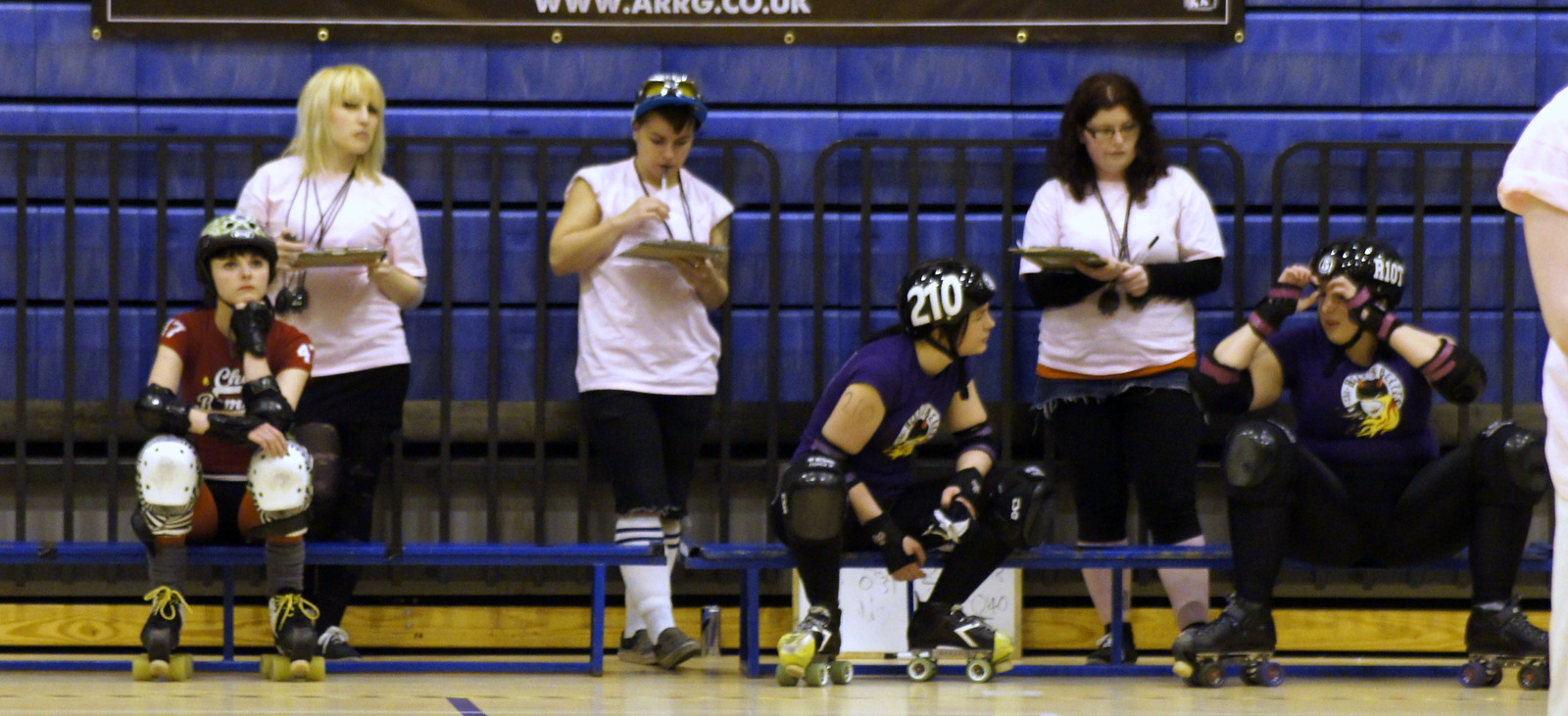 |
| Half time in the sin-bin. |
Period 2
The Cherry Bombers returned to the second period with a one hundred point deficit and change, aware that they'd have to do an awful lot of work to pull out a win. A power-jam start to the first jam gave them a perfect opportunity, with GRD's Rogue Runner on the bench from the end of the first period; and, indeed, despite a very slow start as Hell's Belles tried to wear down the penalty clock, Circuit Breaker broke through, picking up a single scoring pass near simultaneously with Rogue's own initial pass, and calling it.
 |
| This happened rather a lot when Rogue Runner was jamming... |
By jam 15, the score differential had soared to an intimidating:
33 Cherry Bombers : 186 Hell's Belles
With only 11 minutes left in the bout, and a comfortable lead, the Belles began relaxing their jammer rotation, letting some of their less regular jammers into the mix. First up was Mona Rampage, who proved a little less terrifying with a star on her helmet; the Bombers' Demon Speeding effortlessly taking lead jammer and a scoring pass against her. More successfully, Venus Velocity fought past Maulibu Barbie at the front of the pack to take lead jammer over Circuit Breaker. Megan Hyndman, pivoting, kept Circuit from escaping the pack for several passes by Venus, inflating the score by a full 12 points.
 |
| Oates demonstrates why you shouldn't try to pass her when she has a star on her helmet. |
Sensing the need for encouragement from the track side, the Cherry Bombers' Miss Collie Check, not skating, got up and exhorted the home team for the final few jams. Apparently this was the missing ingredient, as up against Megan Hyndman in jam 22, Demon Speeding managed just enough of a lead to score a single point before calling it, bringing the Cherry Bombers' score to its final resting place of 38.
With Mistress Malicious sealing the final jam with a partial scoring pass ahead of a fast-gaining Circuit Breaker, the final score sat at:
38 Cherry Bombers : 214 Hell's Belles

For the report on the final itself, including the skater awards for both bouts, see part 2, here.
Video from the bout is available in a playlist here: http://www.youtube.com/playlist?list=PL6EE40DDB52FD9FA3&feature=view_all
2012/04/28
Bout Report: Glasgow Roller Derby v Stockholm Roller Derby Double Header! 14 April 2012
Not content with just holding one bout at a time, Glasgow Roller Derby's first 3 scheduled events are all double-headers, featuring challengers for both their Maiden Grrders and Irn Bruisers.
While the first event (held last month) and the third (on the 19th of May) pit different leagues against the two Glasgow teams, the 14th of April was particularly special. Stockholm Roller Derby, who had most recently faced Internationally ranked London Roller Girls at home, brought over both their A and B travel teams to play their opposite numbers from GRD.
While Stockholm B fared poorly against the Maiden Grrders, thanks to some penalty issues for the Swedes and some exceptional pack cohesion from the home team, the Irn Bruisers were held to an extremely close bout by Stockholm A, eventually losing to the away team by a mere 2 points!
The "official" bout summary for these bouts from Glasgow Roller Derby is here.
 Coming into the first period, the Maidens asserted their strength; jam 3 seeing a blazingly fast Sarah McMillan (7) taking lead jammer and multiple grand slam passes against a pack-bound Jazz Ass (6), who was unable to defeat Mazzy Chaos (R10T)'s opposition. 24 point jams don't happen very often outside of power jams, and despite taking lead jammer in both of the next 2 jams, Stockholm's Hell N Destroy (24) and Roffe (15) could only chip away at the home team's lead.
Ironically, it was Sarah McMillan who also gave Stockholm their best scoring opportunity, picking up a trip to the penalty bench in jam 7 to hand Mouse Trapper Mary (29) a handy power-jam. The Maiden's pack was no push-over, however, Mazzy Chaos and Haberbashery recycling the Stockholm jammer and generally making life difficult for her - the 8 points she acquired were genuinely hard fought.
With Glasgow forcing a slow start to the next jam to allow their jammer to leave the sin-bin, and subsequently taking lead jammer, Stockholm didn't get any breaks from the home team for the next 9 or 10 jams; Hell n desTroy picking up their only scoring pass of the section in jam 9, but having to push an unbreakable Maidens 4-wall out of play to do so. With Roffe off to the sin-bin for a track cut major apparently when trying to pass her own teammates on the inside-line in the next jam, and a further track-cutting power-jam for the Maidens two jams later as Jazz Ass also headed to the bin, Fightin' Torque and Sarah McMillan took the majority of points for the middle of the period.
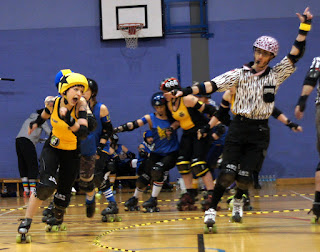 It took until jam 16, 9 minutes before the end of the period, for Stockholm B to get their next scoring opportunity, Roffe picking up a hard-fought couple of points thanks to teammate Crackher (3) keeping Glasgow's Jess E Ska held back in the pack for just long enough. The big score had to wait a few more jams, until jam 18's power jam; as in jam 7, Sarah McMillan off to the bench for the home team after a dense pack forced a cut, handing the track to Hell n desTroy. This time, Stockholm proved wise to the Maiden's techniques, breaking up their four-wall quickly to help their jammer score; despite a good hit from Venus Velocity (666), there were 13 points in the jam for the away team, with Hell n desTroy calling it with the Glasgow jammer still on the bench.
Once again, this tactic failed to gain Stockholm any more points, the Maidens again slowing the pack to allow Sarah McMillan to escape, and subsequently take advantage of her own power jam as an overenthusiastic Roffe picked up a back-block major immediately on impacting the Maidens' rear wall. While Stockholm presented some tough walls, Glasgow's jammer was happy to batter through and around them until being forced to track-cut tip-toeing around pivot Mouse Trapper Mary, earning her own return to the penalty box. Some aggressive blocking from Mazzy Chaos and Mona Rampage (22) limited the returning Roffe to her initial pass before time was called.
Despite a knee-start catapulting Jazz Ass onto track for the best use of the remaining power-jam, Stockholm failed to benefit as yet another trip to the penalty box beckoned during her scoring pass. With McMillan now used to returning from the bench to score, the result was a perhaps predictable 12 point score to the home team before the jam was called.
With the final jam seeing Stockholm take lead jammer for Mouse Trapper Mary, and even recycle GRD's Fightin' Torque, Glasgow's blockers proved too tough on the scoring pass; distracted by attempting to free their jammer from Glasgow's waterfalling in the middle of the pack, Stockholm didn't even see Torque zip through on her own scoring run. Belated calling by Mouse Trapper Mary set the score at the end of the period to:
A 77 point deficit entering the second period on must be daunting, but Stockholm returned to the track clearly unbowed, scoring in the first two jams, with a close initial jam between Roffe and GRD's Fightin' Torque handing them only a single point. While the Bruisers' Splatterkiller looked like owning the second jam, thwarting Jazz Ass's bid for the inside line in an initial tussle before taking lead jammer herself; a track cut major by the Stockholm jammer soon after capped things off with a power-jam to GRD. Making it look initially effortless, Splat picked up a couple of grand slam passes before a misjudged attempt to slip around the inside line ended up in a major track cut of her own, giving Jazz Ass the chance to score for herself. An extremely defensive Glasgow pack made it as hard as possible for her, however, and the power-jam, and the jam itself, ended before she completed her first scoring pass.
 With the Maidens in an increasingly dominant position, the Swedes were given few chances to score for the rest of the bout; not helped by a confused Roffe apparently trying to start without everyone else in jam 4. With Roffe required to reenter the pack as they passed her advanced position, GRD's Fightin' Torque had already made inroads into her own initial pass before the Stockholm jammer could properly start…
An increasingly dominant Maiden Grrders gave Stockholm few chances for the rest of the bout, keeping them to only two scoring passes until the final 10 minutes. The first of these two moments of glory turned to ashes, however, as Mouse Trapper Mary apparently didn't realise that she'd been pushed off track by Jackash (911) on her scoring pass, picking up a trip to the sin-bin for the resulting track cut major. Sarah McMillan's resultant power-jam, despite some solid walls anchored by Polygamy Winehouse, did the score differential no favours for Stockholm at all.
A second power-jam to McMillan (again, versus Mouse Trapper Mary) later in the period just inflated an already impressive lead for the home team, although some beautifully coherent pack work from the Maidens did allow her to collect a final pass even after the Stockholm jammer returned to the track, for a 24 point jam in total!
With around 9 minutes to go, Stockholm finally found their feet once more; extremely defensive pack tactics from both teams seeing Stockholm's 4:3 pack advantage eventually hand Roffe lead jammer status for jam 15, and enough time for a clean scoring pass. Rushing to pick up points as Roffe called it, GRD's Very Hungry Splatterkiller managed to collide with a Polygamy Winehouse from the back, picking up a last second back-block major. Stockholm's Jazz Ass was happy to take the following power-jam; with both teams down to only 2 blockers on track, the Maidens couldn't really do much to stop her initially. Some excellent blocking from Mona Rampage held back her second pass for long enough for a returning Coco Pox to push the track advantage Glasgow's way, however, and as the power-jam ended, another one had just begun; Jazz Ass being forced to pick up enough track cut minors to send her off herself. Despite a hard fall onto her knee, Splat showed how you run a power-jam, picking up 3 grand slam passes, making the jam a net Maidens gain.
The game of musical power-jams continued into the following jam, however; with Fightin' Torque facing only a pair of Stockholm blockers, and rushing to score before the dregs of the power-jam ran through, she somehow managed to contrive to emulate Splat and collide forcefully with their packs on her first scoring pass, earning an immediate trip to the penalty bench. A returning Jazz Ass didn't do much better, with four Maidens blockers to pass, she picked up a track cut major instead! A more cautious Torque still eked 2 grand slam passes out of her brief sole ownership of the track, and a returning Jazz Ass was ably managed by Mazzy Chaos and Haberbashery to let her pick up a third pass before the jam ended.
That was the final scoring opportunity for Stockholm's B team, with the final three jams seeing a third successive power jam for GRD, and two excellent displays of skill by the home team; Fightin' Torque managing to leap her way to a 9 point jam to cap off the bout, thanks to some beautiful blocking from Mona Rampage.
The final score, with those last minute scores, an impressive:
!
After that impressive victory by Glasgow's B team, Stockholm A were up to show that the Swedes were not entirely to be messed with.
Opening the first period against Glasgow's Irn Bruisers, Stockholm held the first 3 jams, Mad Maloony (22) outpacing Glasgow's Megan Hyndman (4) in the first to force a no-score, and Blood Countess (1300) and Hell n desTroy (24) both taking lead jammer themselves for points.
Glasgow weren't napping, however, and the next two jams saw Megan Hyndman and Hardcore Prawn (88mph) bring the scores back to an even 5:6, before jam 6 started their acceleration away. Chemikill Hazard (LD50) and Oates (360) worked together in the pack to hold Blood Countess at bay while Marshall Lawless (42) took lead jammer and a pair of grand slam passes to open up the score gap.
 With Blood Countess off to the penalty box towards the end of the jam, Stockholm were well aware of the danger in the next. Despite the power jam, some exceptional walling by Only (1) and Kix Deville (90) anchored by Swede Hurt (46) shut down much of Megan Hyndman's scoring, limiting GRD to just 6 points before the Stockholm jammer returned to the track.
As Hardcore Prawn slipped out along the outside line within seconds of the next jam starting, Stockholm's Taraism found herself lapped before she could finally pass Chemkill Hazard at the rear of the pack; with the grand slam pass under her belt, Glasgow's jammer was happy to call the jam as soon as she impacted the pack a second time.
Jam 9 saw Hell n desTroy start the Stockholm counterattack, taking lead jammer and, aided by pivot Swede Hurt (46) keeping Glasgow's Rogue Runner (210) controlled at the rear of the pack, completing her own scoring pass in good time. Mad Maloony accelerated the scoring in jam 10, winning her third rematch with Megan Hyndman, and with the GRD jammer staggered down by an assisted check from captain Hussinsane (747) and Taraism, having enough time to pick up 5 points before calling.
 It took a little bad luck for Glasgow to really open up the possibilities for Stockholm in the next, short-lived, jam. A tough pack holding both jammers past the second corner saw Stockholm's Taraism through first to take lead jammer. Marshall Lawless pursued just a little too aggressively, however, colliding immediately with the opposing skater and taking both to the floor, where the Swedish jammer called it; near simultaneously, Lawless picked up a back block major, meaning that the next jam would be a power jam for the away team.
Mad Malooney took the jam line, and despite some tenacious (and out-of-play penalty accruing) blocking by Becki Menzies (5), she kept up the pressure, pulling out a a trio of grand slam passes before Marshall Lawless, accelerating like a rocket out of the bench and through the pack as her penalty time expired, forced her to call it. 15 points was just enough to bring the scores nicely level at:
The game was clearly still up for anyone to win. With the two teams trading points, the scores still began to slip slightly the Bruisers' way, with jam 16 in particular showing some excellent play; Rogue Runner patiently working at a tough Stockholm 4-wall until it was forced out of play at the front of the pack, while, despite their 4-3 numbers disadvantage, Glasgow's blockers kept Taraism locked up long enough for a grand slam scoring pass, followed by a second pass after she escaped.
Stockholm were hardly about to give up, of course, and some good play from Mad Maloony and Blood Countess was starting to make up the points differential again over the following 4 jams.
With two jams to go before the end of the period, Marshall Lawless just about exploded out of pack in the first, to take lead jammer and a single scoring pass; Megan Hyndman tried to do the same in the second, but a more solid Stockholm wall forced a minor penalty before it was put out of play, robbing her of lead jammer status. With GRD now all about keeping the Stockholm jammer controlled, Viper started off with a comparatively gentle hip check… knocking Hell n desTroy to the track, where she grimaced and failed to get up. With the jam called for medical attention, that was the last chance Stockholm would get to score before the next period; although, of course, their immediate concerns were more with the injured jammer; happily, she managed to hobble off after some icing from the medical staff.
 Half time came and saw a special message and good-bye to Glasgow's well-loved Lola Bruises, who had announced her intention to retire from roller derby for new challenges. As Laura Hoy, then, she was given a big, derby-dog-pile send-off, and a donation to the British Heart Foundation, for which she is running a charitable marathon.
Coming into the second period, Hell n desTroy was too injured to return to play, and was forced to sit out the rest of the game. Stockholm's jammers weren't the only casualties of the first half; Referee Darth Headwreckher was also injured out, being replaced as jam referee by Urine Trouble, who had refereed for the previous bout.
With the Irn Bruisers only 15 points in the lead at the start of the second period this was still anyone's game; something that was reinforced when, after two lowish scoring jams for the Bruisers, jam 3 saw Emma Ryssfemma (5mg) take advantage of a track cut by Marshall Lawless to slash the points differential to only 5 points in a single power jam.
Despite some excellent work by Hardcore Prawn jamming, and Chemikill Hazard blocking, pulling Glasgow's score ahead in the next jam, a second power jam for Stockholm in jam 5 allowed Taraism (116) to push her team into the lead for the first time since the 4th jam of the bout.
While an immediately subsequent power jam for the Bruisers allowed Oates to snatch back the lead, despite some excellent walling from STRD's Bess Irv Cold (50) and captain Hussinsane (747), it was clear that the home team's victory was increasingly uncertain.
 The home team only barely defended their lead over the next five jams, repeated in-roads by Mad Maloony each time she was up being overturned the next jam by Megan Hyndman in a kind of jammer battle by turns. Finally, after a Stockholm time-out, the away team managed to crack it with a modified strategy, Kix Deville (90) and Hussinsane keeping Rogue Runner at bay in the pack, and giving Mad Maloony the time she needed to score multiple passes... pushing the Swedes into the lead by a single point:
A complex jam followed; Swede Hurt giving Hardcore Prawn repeated hard shoulder checks to keep her in the pack, while Blood Countess managed to take lead jammer with a small apex leap. With Prawn still being hammered by Swede, the Stockholm jammer wasn't having such a good time of it in her scoring pass either, Mistress Malicious (99) and Becki Menzies both hammering her just as hard. Eventually, a track cut sent Blood Countess to the sin-bin, but a beleaguered Hardcore Prawn only just managed a single scoring pass, still being repeatedly recycled, before Blood Countess returned to the track and called it.
With only 11 minutes left in the bout, the scores had drawn once again, sitting at
 With both teams pulling out all the stops, it was Stockholm who began to slowly pull away first; a close no-score between Oates and Mad Maloony followed by the precise opposite, a no-lead jammer (thanks to penalties for both Marshall Lawless and Blood Countess) 2 minute extravaganza, with both teams providing near-impenetrable opposition. Over the entire jam, Stockholm managed to sneak in a single scoring pass, such was the intensity of the play from both sides.
Mad Maloony made it another 3 points in the next jam, but couldn't stop a close Megan Hyndman from scoring equally; a very fast Oates made it another 3 for Glasgow in the very next jam, resetting the scores to near parity again. With Marshall Lawless barely fighting ahead to a single scoring pass in jam 18, the lead was changing almost every other jam!
A pair of very close jams broke the trend, for 19 and 20, with Emma Ryssfemma and Rogue Runner, and Megan Hyndman and Mad Maloony, too close to really call; the first a no-score, the second slightly misjudged by Hyndman but with no real impact - both scoring a single point, and leaving the Irn Bruiser still barely in the lead:
With only enough time for a couple more jams, Stockholm's captain Hussinsane managed a last minute reversal, with a tough rear wall keeping the Bruisers' Oates locked up in the pack. Despite Glasgow pulling out their own tough defence on her scoring pass, Mistress Malicious knocking her to the track as she approached, the STRD jammer still managed a grand slam pass before calling it, pulling the away team ahead by a mere 2 points.
Glasgow immediately called a team timeout, strategising and morale building for the final, and potentially pivotal, jam of the bout. In the end, it came down once more to a rematch of Megan Hyndman against Mad Maloony; with both teams fighting as hard as they could to gain advantage, both jammers had promising forays shut down, until a broadly grinning Mad Maloony finally broke through first! With Hyndman in close pursuit, the Stockholm jammer settled for calling the jam as she approached the pack once more, having ensured the period clock had fully expired.
At the end of a nail-biting period, then, the final score remained at:
The Maiden Grrders are quickly becoming one of the most impressive "B" teams for this season. After their performance against Granite City in their previous bout, and their comprehensive win here, they're consistently showing skill and determination that you might expect of an "A" team from some other leagues.
The second bout of the day was a much closer fought affair, and while Stockholm certainly earned their win, the same would have been true for the Irn Bruisers; both teams can be more than happy with their performance on track.
Disclaimers and Acknowledgements
While the first event (held last month) and the third (on the 19th of May) pit different leagues against the two Glasgow teams, the 14th of April was particularly special. Stockholm Roller Derby, who had most recently faced Internationally ranked London Roller Girls at home, brought over both their A and B travel teams to play their opposite numbers from GRD.
While Stockholm B fared poorly against the Maiden Grrders, thanks to some penalty issues for the Swedes and some exceptional pack cohesion from the home team, the Irn Bruisers were held to an extremely close bout by Stockholm A, eventually losing to the away team by a mere 2 points!
The "official" bout summary for these bouts from Glasgow Roller Derby is here.
Maidens v STRD
Period 1
 Coming into the first period, the Maidens asserted their strength; jam 3 seeing a blazingly fast Sarah McMillan (7) taking lead jammer and multiple grand slam passes against a pack-bound Jazz Ass (6), who was unable to defeat Mazzy Chaos (R10T)'s opposition. 24 point jams don't happen very often outside of power jams, and despite taking lead jammer in both of the next 2 jams, Stockholm's Hell N Destroy (24) and Roffe (15) could only chip away at the home team's lead.
Ironically, it was Sarah McMillan who also gave Stockholm their best scoring opportunity, picking up a trip to the penalty bench in jam 7 to hand Mouse Trapper Mary (29) a handy power-jam. The Maiden's pack was no push-over, however, Mazzy Chaos and Haberbashery recycling the Stockholm jammer and generally making life difficult for her - the 8 points she acquired were genuinely hard fought.
With Glasgow forcing a slow start to the next jam to allow their jammer to leave the sin-bin, and subsequently taking lead jammer, Stockholm didn't get any breaks from the home team for the next 9 or 10 jams; Hell n desTroy picking up their only scoring pass of the section in jam 9, but having to push an unbreakable Maidens 4-wall out of play to do so. With Roffe off to the sin-bin for a track cut major apparently when trying to pass her own teammates on the inside-line in the next jam, and a further track-cutting power-jam for the Maidens two jams later as Jazz Ass also headed to the bin, Fightin' Torque and Sarah McMillan took the majority of points for the middle of the period.

41 Stockholm B : 94 Maiden Grrders
Once again, this tactic failed to gain Stockholm any more points, the Maidens again slowing the pack to allow Sarah McMillan to escape, and subsequently take advantage of her own power jam as an overenthusiastic Roffe picked up a back-block major immediately on impacting the Maidens' rear wall. While Stockholm presented some tough walls, Glasgow's jammer was happy to batter through and around them until being forced to track-cut tip-toeing around pivot Mouse Trapper Mary, earning her own return to the penalty box. Some aggressive blocking from Mazzy Chaos and Mona Rampage (22) limited the returning Roffe to her initial pass before time was called.
Despite a knee-start catapulting Jazz Ass onto track for the best use of the remaining power-jam, Stockholm failed to benefit as yet another trip to the penalty box beckoned during her scoring pass. With McMillan now used to returning from the bench to score, the result was a perhaps predictable 12 point score to the home team before the jam was called.
With the final jam seeing Stockholm take lead jammer for Mouse Trapper Mary, and even recycle GRD's Fightin' Torque, Glasgow's blockers proved too tough on the scoring pass; distracted by attempting to free their jammer from Glasgow's waterfalling in the middle of the pack, Stockholm didn't even see Torque zip through on her own scoring run. Belated calling by Mouse Trapper Mary set the score at the end of the period to:
43 Stockholm B : 120 Maiden Grrders
Period 2
A 77 point deficit entering the second period on must be daunting, but Stockholm returned to the track clearly unbowed, scoring in the first two jams, with a close initial jam between Roffe and GRD's Fightin' Torque handing them only a single point. While the Bruisers' Splatterkiller looked like owning the second jam, thwarting Jazz Ass's bid for the inside line in an initial tussle before taking lead jammer herself; a track cut major by the Stockholm jammer soon after capped things off with a power-jam to GRD. Making it look initially effortless, Splat picked up a couple of grand slam passes before a misjudged attempt to slip around the inside line ended up in a major track cut of her own, giving Jazz Ass the chance to score for herself. An extremely defensive Glasgow pack made it as hard as possible for her, however, and the power-jam, and the jam itself, ended before she completed her first scoring pass.
47 Stockholm B : 133 Maiden Grrders
 With the Maidens in an increasingly dominant position, the Swedes were given few chances to score for the rest of the bout; not helped by a confused Roffe apparently trying to start without everyone else in jam 4. With Roffe required to reenter the pack as they passed her advanced position, GRD's Fightin' Torque had already made inroads into her own initial pass before the Stockholm jammer could properly start…
An increasingly dominant Maiden Grrders gave Stockholm few chances for the rest of the bout, keeping them to only two scoring passes until the final 10 minutes. The first of these two moments of glory turned to ashes, however, as Mouse Trapper Mary apparently didn't realise that she'd been pushed off track by Jackash (911) on her scoring pass, picking up a trip to the sin-bin for the resulting track cut major. Sarah McMillan's resultant power-jam, despite some solid walls anchored by Polygamy Winehouse, did the score differential no favours for Stockholm at all.
50 Stockholm B : 164 Maiden Grrders
A second power-jam to McMillan (again, versus Mouse Trapper Mary) later in the period just inflated an already impressive lead for the home team, although some beautifully coherent pack work from the Maidens did allow her to collect a final pass even after the Stockholm jammer returned to the track, for a 24 point jam in total!
With around 9 minutes to go, Stockholm finally found their feet once more; extremely defensive pack tactics from both teams seeing Stockholm's 4:3 pack advantage eventually hand Roffe lead jammer status for jam 15, and enough time for a clean scoring pass. Rushing to pick up points as Roffe called it, GRD's Very Hungry Splatterkiller managed to collide with a Polygamy Winehouse from the back, picking up a last second back-block major. Stockholm's Jazz Ass was happy to take the following power-jam; with both teams down to only 2 blockers on track, the Maidens couldn't really do much to stop her initially. Some excellent blocking from Mona Rampage held back her second pass for long enough for a returning Coco Pox to push the track advantage Glasgow's way, however, and as the power-jam ended, another one had just begun; Jazz Ass being forced to pick up enough track cut minors to send her off herself. Despite a hard fall onto her knee, Splat showed how you run a power-jam, picking up 3 grand slam passes, making the jam a net Maidens gain.
65 Stockholm B : 229 Maiden Grrders
The game of musical power-jams continued into the following jam, however; with Fightin' Torque facing only a pair of Stockholm blockers, and rushing to score before the dregs of the power-jam ran through, she somehow managed to contrive to emulate Splat and collide forcefully with their packs on her first scoring pass, earning an immediate trip to the penalty bench. A returning Jazz Ass didn't do much better, with four Maidens blockers to pass, she picked up a track cut major instead! A more cautious Torque still eked 2 grand slam passes out of her brief sole ownership of the track, and a returning Jazz Ass was ably managed by Mazzy Chaos and Haberbashery to let her pick up a third pass before the jam ended.
That was the final scoring opportunity for Stockholm's B team, with the final three jams seeing a third successive power jam for GRD, and two excellent displays of skill by the home team; Fightin' Torque managing to leap her way to a 9 point jam to cap off the bout, thanks to some beautiful blocking from Mona Rampage.
The final score, with those last minute scores, an impressive:
69 Stockholm B : 285 Maiden Grrders
!
Bruisers v STRD
Period 1
After that impressive victory by Glasgow's B team, Stockholm A were up to show that the Swedes were not entirely to be messed with.
Opening the first period against Glasgow's Irn Bruisers, Stockholm held the first 3 jams, Mad Maloony (22) outpacing Glasgow's Megan Hyndman (4) in the first to force a no-score, and Blood Countess (1300) and Hell n desTroy (24) both taking lead jammer themselves for points.
Glasgow weren't napping, however, and the next two jams saw Megan Hyndman and Hardcore Prawn (88mph) bring the scores back to an even 5:6, before jam 6 started their acceleration away. Chemikill Hazard (LD50) and Oates (360) worked together in the pack to hold Blood Countess at bay while Marshall Lawless (42) took lead jammer and a pair of grand slam passes to open up the score gap.
 With Blood Countess off to the penalty box towards the end of the jam, Stockholm were well aware of the danger in the next. Despite the power jam, some exceptional walling by Only (1) and Kix Deville (90) anchored by Swede Hurt (46) shut down much of Megan Hyndman's scoring, limiting GRD to just 6 points before the Stockholm jammer returned to the track.
As Hardcore Prawn slipped out along the outside line within seconds of the next jam starting, Stockholm's Taraism found herself lapped before she could finally pass Chemkill Hazard at the rear of the pack; with the grand slam pass under her belt, Glasgow's jammer was happy to call the jam as soon as she impacted the pack a second time.
5 Stockholm A : 29 Irn Bruisers
Jam 9 saw Hell n desTroy start the Stockholm counterattack, taking lead jammer and, aided by pivot Swede Hurt (46) keeping Glasgow's Rogue Runner (210) controlled at the rear of the pack, completing her own scoring pass in good time. Mad Maloony accelerated the scoring in jam 10, winning her third rematch with Megan Hyndman, and with the GRD jammer staggered down by an assisted check from captain Hussinsane (747) and Taraism, having enough time to pick up 5 points before calling.

Mad Malooney took the jam line, and despite some tenacious (and out-of-play penalty accruing) blocking by Becki Menzies (5), she kept up the pressure, pulling out a a trio of grand slam passes before Marshall Lawless, accelerating like a rocket out of the bench and through the pack as her penalty time expired, forced her to call it. 15 points was just enough to bring the scores nicely level at:
29 Stockholm A : 29 Irn Bruisers
The game was clearly still up for anyone to win. With the two teams trading points, the scores still began to slip slightly the Bruisers' way, with jam 16 in particular showing some excellent play; Rogue Runner patiently working at a tough Stockholm 4-wall until it was forced out of play at the front of the pack, while, despite their 4-3 numbers disadvantage, Glasgow's blockers kept Taraism locked up long enough for a grand slam scoring pass, followed by a second pass after she escaped.
Stockholm were hardly about to give up, of course, and some good play from Mad Maloony and Blood Countess was starting to make up the points differential again over the following 4 jams.
With two jams to go before the end of the period, Marshall Lawless just about exploded out of pack in the first, to take lead jammer and a single scoring pass; Megan Hyndman tried to do the same in the second, but a more solid Stockholm wall forced a minor penalty before it was put out of play, robbing her of lead jammer status. With GRD now all about keeping the Stockholm jammer controlled, Viper started off with a comparatively gentle hip check… knocking Hell n desTroy to the track, where she grimaced and failed to get up. With the jam called for medical attention, that was the last chance Stockholm would get to score before the next period; although, of course, their immediate concerns were more with the injured jammer; happily, she managed to hobble off after some icing from the medical staff.
53 Stockholm A : 68 Irn Bruisers
Half time

Period 2
With the Irn Bruisers only 15 points in the lead at the start of the second period this was still anyone's game; something that was reinforced when, after two lowish scoring jams for the Bruisers, jam 3 saw Emma Ryssfemma (5mg) take advantage of a track cut by Marshall Lawless to slash the points differential to only 5 points in a single power jam.
73 Stockholm A : 78 Irn Bruisers
Despite some excellent work by Hardcore Prawn jamming, and Chemikill Hazard blocking, pulling Glasgow's score ahead in the next jam, a second power jam for Stockholm in jam 5 allowed Taraism (116) to push her team into the lead for the first time since the 4th jam of the bout.
While an immediately subsequent power jam for the Bruisers allowed Oates to snatch back the lead, despite some excellent walling from STRD's Bess Irv Cold (50) and captain Hussinsane (747), it was clear that the home team's victory was increasingly uncertain.

105 Stockholm A : 104 Irn Bruisers
A complex jam followed; Swede Hurt giving Hardcore Prawn repeated hard shoulder checks to keep her in the pack, while Blood Countess managed to take lead jammer with a small apex leap. With Prawn still being hammered by Swede, the Stockholm jammer wasn't having such a good time of it in her scoring pass either, Mistress Malicious (99) and Becki Menzies both hammering her just as hard. Eventually, a track cut sent Blood Countess to the sin-bin, but a beleaguered Hardcore Prawn only just managed a single scoring pass, still being repeatedly recycled, before Blood Countess returned to the track and called it.
With only 11 minutes left in the bout, the scores had drawn once again, sitting at
109 Stockholm A : 109 Irn Bruisers
 With both teams pulling out all the stops, it was Stockholm who began to slowly pull away first; a close no-score between Oates and Mad Maloony followed by the precise opposite, a no-lead jammer (thanks to penalties for both Marshall Lawless and Blood Countess) 2 minute extravaganza, with both teams providing near-impenetrable opposition. Over the entire jam, Stockholm managed to sneak in a single scoring pass, such was the intensity of the play from both sides.
Mad Maloony made it another 3 points in the next jam, but couldn't stop a close Megan Hyndman from scoring equally; a very fast Oates made it another 3 for Glasgow in the very next jam, resetting the scores to near parity again. With Marshall Lawless barely fighting ahead to a single scoring pass in jam 18, the lead was changing almost every other jam!
A pair of very close jams broke the trend, for 19 and 20, with Emma Ryssfemma and Rogue Runner, and Megan Hyndman and Mad Maloony, too close to really call; the first a no-score, the second slightly misjudged by Hyndman but with no real impact - both scoring a single point, and leaving the Irn Bruiser still barely in the lead:
117 Stockholm A : 120 Irn Bruisers
With only enough time for a couple more jams, Stockholm's captain Hussinsane managed a last minute reversal, with a tough rear wall keeping the Bruisers' Oates locked up in the pack. Despite Glasgow pulling out their own tough defence on her scoring pass, Mistress Malicious knocking her to the track as she approached, the STRD jammer still managed a grand slam pass before calling it, pulling the away team ahead by a mere 2 points.
Glasgow immediately called a team timeout, strategising and morale building for the final, and potentially pivotal, jam of the bout. In the end, it came down once more to a rematch of Megan Hyndman against Mad Maloony; with both teams fighting as hard as they could to gain advantage, both jammers had promising forays shut down, until a broadly grinning Mad Maloony finally broke through first! With Hyndman in close pursuit, the Stockholm jammer settled for calling the jam as she approached the pack once more, having ensured the period clock had fully expired.
At the end of a nail-biting period, then, the final score remained at:
122 Stockholm A : 120 Irn Bruisers
Conclusions and Awards
The Maiden Grrders are quickly becoming one of the most impressive "B" teams for this season. After their performance against Granite City in their previous bout, and their comprehensive win here, they're consistently showing skill and determination that you might expect of an "A" team from some other leagues.
The second bout of the day was a much closer fought affair, and while Stockholm certainly earned their win, the same would have been true for the Irn Bruisers; both teams can be more than happy with their performance on track.
|
| ||||||||||||||||||||||||||||
Thanks to Glasgow Roller Derby and Stockholm Roller Derby for two fantastic bouts.
Thanks also to the producer of the bout programme, and the GRD and STRD tweeters and Facebook-page-responders, who were essential in attaining the skater award details.
Photos:
GRD v STRD
Maidens:
Video:
GRD v STRD
Maidens: http://www.youtube.com/playlist?list=PLA0302FE6DD700F36&feature=view_all
Bruisers: http://www.youtube.com/playlist?list=PLC65964E791D67830&feature=view_all
Maidens: http://www.youtube.com/playlist?list=PLA0302FE6DD700F36&feature=view_all
Bruisers: http://www.youtube.com/playlist?list=PLC65964E791D67830&feature=view_all
This report, and all photographs and video linked therein, are licensed Creative Commons: Attribution (3.0) (CC:BY 3.0). Free for reuse and redistribution with attribution.
Photographs and video taken with a Sony A580 with a Minolta 34-105mm lens.
2012/04/18
Bout Report: ARRG Home Season 2012: Cherry Bombers v The Skatefast Club 7th April 2012
The 7th of April saw the final qualifying round in Auld Reekie Roller Girls' first ever home teams season. With the Leithal Weapons already through to the final, undefeated, this bout would decide which of the Cherry Bombers and The Skatefast Club would face them once again.
Before the bout started, evidence seemed to favour the Bombers; their bout against the Leithals was a much closer loss than the lemon-and-grey Skatefasts attained. However, with both teams having learned from their losses, and the Skatefast Club playing Team Scotland jammer Blazin' Phoenix for her first bout this season, there was everything to play for.
The first period started with both teams almost indistinguishable in skill, trading scoring passes in the first two jams. Jam 3 looked like seeing the start of a Skatefast run, as the Cherry Bombers' Maulibu Barbie (581) was kept controlled in the pack by an excellent initial wall anchored by Crazylegs (11), and some tenacious blocking by Blazin' Phoenix (28) and pivot and captain Mallory Powers (9), while the Skatefast Club's own Double D'struction (34) powered through Depeche Maude (1337) and AdrenaLin Rush (22) to take lead and two grand slam passes before calling it. The Bombers kept the following jam to a no-score, but couldn't prevent another display of dominance from The Skatefast Club in jam 5, a 4-3 pack advantage handing them the leverage to push Sweet Sinner through the pack while Crazylegs and Mallory Powers blocked the Bombers' Circuit Breaker (100) at the front long enough for a grand slam pass, and a second scoring pass once Circuit had escaped!
With the lemon team starting to edge ahead slowly, the 6th jam provided a counterbalance, a power-jam for giving the Bombers' Zillah (555) a chance to reverse the trend. In fact, she picked up exactly 20 points, bringing the scores to a tied
with still 22 minutes in the period.
The very next jam looked like giving the Bombers cause for more celebrations, with Skatefast's Blazin' Phoenix taking lead jammer ahead of Circuit Breaker (100) only to pick up penalties blocking against pivot VeloSidy (16) on her scoring pass, handing another power-jam to the women in red. The Bombers took good advantage, despite some effective teamwork from Skatefast's Skinn'er Alive (85) and Crazylegs (the only Skatefast blockers on track) with Circuit managing to pick up a solid scoring pass. With Apocalypse Cow (77) returning from the bench for Skatefast, the blocking got tougher, and a besieged Circuit eventually accumulated enough penalties for a trip to the sin-bin herself, moments after as Blaze was left it. With enough time on the clock for a couple of scoring passes for her own team, the Skatefast jammer, and Team Scotland skater, showed what she was made of, clearing the pack with an impressive leap on the inside corner, and taking 9 points as the whistle blew.
Coming into jam 9, with the power jam still in effect for The Skatefast Club, Lilo And Stitches (626) was hoping to widen the points differential a little while she had the chance. A tough wall from Bronx Betty (319) and Maulibu Barbie saw her pick up what looked like a forearms penalty for her trouble, and a trip to the penalty bench instead, releasing Circuit Breaker for her own brief shot at scoring. With only Skatefast Captain Mallory Powers and Mo B Quick (66) on track, the Bombers picked up 2 points in their brief time on track, Circuit calling it as she saw her power jam end.
With Zillah and Sweet Sinner (99) proving equally matched on track in jam 10, things were looking very close for between the two contestants, with still 15 minutes to go.
Good control of the next 3 jams saw the Skatefast Club slowly start to pull away again, building up a 7 point lead with Mo B Quick and Blazin' Phoenix eking away at the score in tight races against the Bombers' Circuit Breaker and Zillah.
The 13th jam signalled the change of all that: Bronx Betty and Cherry Bombers' jammer Maulibu Barbie both forcing Skatefast's Sweet Sinner to cut track and pick up a trip to the penalty box during her initial pass. Repeated recycling of the Bombers jammer by Skatefast VC Crotch Lightning (T10) as she hit strong anchored walls on every pass helped to keep the scoring down a little, but the jam still ended with the entire Skatefast lead removed and the Bombers ahead at:
While a pair of tight no-scores between Circuit Breaker and Blazin' Phoenix, and Maulibu Barbie and Bint Imperial (893) threatened to remove the Cherry Bombers' momentum, the following 3 jams saw more gains by the Bombers, thanks to another power-jam for Zillah against Blazin' Phoenix in jam 17. With the Skatefast jammer off right at the start of the jam, Zillah fought through more of those tough Skatefast anchored walls, with a bit of help from Bronx Betty, to pick up 12 points before calling. With another scoring pass from Maulibu Barbie in the following jam, against a delayed Skinn'er Alive, the Bombers were now starting to seriously pull away.
It wasn't to last for long, though, jam 19 seeing some superlative blocking from Double D'struction and Mallory Powers, despite a 4-2 pack disadvantage; sheparding Sweet Sinner to lead jammer, and recycling Circuit Breaker during multiple grand-slam passes. 13 points later, two-thirds of the points differential before the jam, the Skatefast Club were looking back in the fighting seat, with only 5 minutes left in the period.
 While Maulibu Barbie managed to just outpace Blazin' Phoenix through the pack (despite the Skatefast jammer being blocked much further back) for long enough to pick up 2 points for the Bombers, it was very much The Skatefast Club's time. After another close jam, Bint Imperial failing to make enough space from Zillah to score, the 22nd and second-last jam of the period was to show that.
Starting with 4-3 pack advantage once more, the lemon team were still almost unable to stop Maulibu Barbie from taking lead jammer; a passing block from a fast moving Mo B Quick, jamming herself, was the final piece necessary to stop her. Once knocked down once, the Bombers' jammer found it hard to escape the pack once more, with Crotch Lighting and Mallory Powers working together to repeatedly recycle her far back along the track. Another 15 point non-power-jam resulted, and a lead change: The Skatefast Club were now ahead by 5 points!
A last second rally by the Cherry Bombers, Zillah surging through the pack to take lead jammer, and a single scoring pass, ahead of Sweet Sinner, wasn't quite enough to overturn the advantage, and with the next jam set up but out of time before the whistle, the score at half-time still (barely) favoured Skatefast.
Before the bout started, evidence seemed to favour the Bombers; their bout against the Leithals was a much closer loss than the lemon-and-grey Skatefasts attained. However, with both teams having learned from their losses, and the Skatefast Club playing Team Scotland jammer Blazin' Phoenix for her first bout this season, there was everything to play for.
First Period
 |
| Double D'struction goes for another scoring pass as Blaze keeps Maulibu Barbie under control. |
23 Cherry Bombers : 23 The Skatefast Club
The very next jam looked like giving the Bombers cause for more celebrations, with Skatefast's Blazin' Phoenix taking lead jammer ahead of Circuit Breaker (100) only to pick up penalties blocking against pivot VeloSidy (16) on her scoring pass, handing another power-jam to the women in red. The Bombers took good advantage, despite some effective teamwork from Skatefast's Skinn'er Alive (85) and Crazylegs (the only Skatefast blockers on track) with Circuit managing to pick up a solid scoring pass. With Apocalypse Cow (77) returning from the bench for Skatefast, the blocking got tougher, and a besieged Circuit eventually accumulated enough penalties for a trip to the sin-bin herself, moments after as Blaze was left it. With enough time on the clock for a couple of scoring passes for her own team, the Skatefast jammer, and Team Scotland skater, showed what she was made of, clearing the pack with an impressive leap on the inside corner, and taking 9 points as the whistle blew.
 |
| Mo B Quick calls it, although Circuit isn't in a position to score... |
With Zillah and Sweet Sinner (99) proving equally matched on track in jam 10, things were looking very close for between the two contestants, with still 15 minutes to go.
Good control of the next 3 jams saw the Skatefast Club slowly start to pull away again, building up a 7 point lead with Mo B Quick and Blazin' Phoenix eking away at the score in tight races against the Bombers' Circuit Breaker and Zillah.
The 13th jam signalled the change of all that: Bronx Betty and Cherry Bombers' jammer Maulibu Barbie both forcing Skatefast's Sweet Sinner to cut track and pick up a trip to the penalty box during her initial pass. Repeated recycling of the Bombers jammer by Skatefast VC Crotch Lightning (T10) as she hit strong anchored walls on every pass helped to keep the scoring down a little, but the jam still ended with the entire Skatefast lead removed and the Bombers ahead at:
46 Cherry Bombers : 40 The Skatefast Club
While a pair of tight no-scores between Circuit Breaker and Blazin' Phoenix, and Maulibu Barbie and Bint Imperial (893) threatened to remove the Cherry Bombers' momentum, the following 3 jams saw more gains by the Bombers, thanks to another power-jam for Zillah against Blazin' Phoenix in jam 17. With the Skatefast jammer off right at the start of the jam, Zillah fought through more of those tough Skatefast anchored walls, with a bit of help from Bronx Betty, to pick up 12 points before calling. With another scoring pass from Maulibu Barbie in the following jam, against a delayed Skinn'er Alive, the Bombers were now starting to seriously pull away.
It wasn't to last for long, though, jam 19 seeing some superlative blocking from Double D'struction and Mallory Powers, despite a 4-2 pack disadvantage; sheparding Sweet Sinner to lead jammer, and recycling Circuit Breaker during multiple grand-slam passes. 13 points later, two-thirds of the points differential before the jam, the Skatefast Club were looking back in the fighting seat, with only 5 minutes left in the period.
 While Maulibu Barbie managed to just outpace Blazin' Phoenix through the pack (despite the Skatefast jammer being blocked much further back) for long enough to pick up 2 points for the Bombers, it was very much The Skatefast Club's time. After another close jam, Bint Imperial failing to make enough space from Zillah to score, the 22nd and second-last jam of the period was to show that.
Starting with 4-3 pack advantage once more, the lemon team were still almost unable to stop Maulibu Barbie from taking lead jammer; a passing block from a fast moving Mo B Quick, jamming herself, was the final piece necessary to stop her. Once knocked down once, the Bombers' jammer found it hard to escape the pack once more, with Crotch Lighting and Mallory Powers working together to repeatedly recycle her far back along the track. Another 15 point non-power-jam resulted, and a lead change: The Skatefast Club were now ahead by 5 points!
A last second rally by the Cherry Bombers, Zillah surging through the pack to take lead jammer, and a single scoring pass, ahead of Sweet Sinner, wasn't quite enough to overturn the advantage, and with the next jam set up but out of time before the whistle, the score at half-time still (barely) favoured Skatefast.
71 Cherry Bombers : 72 The Skatefast Club
2012/03/19
Bout Report: Glasgow Roller Derby v Granite City Roller Girls & Berlin Bombshells
For the last month or two, Glasgow Roller Girls had been hinting fairly heavily that they have something special up their sleeves for their first home bouts of the season.
On March 10th, the 5th anniversary of the founding of Glasgow Roller Girls, we finally saw the secret unveiled: a complete rebranding and relaunching as the more inclusive "Glasgow Roller Derby", with new boutfits (in striking black and yellow), logo and very professional looking website.
In order to celebrate this rebirth, Glasgow Roller Derby had organised a double header: the B-team Maiden Grrders playing Granite City Roller Girls' Northern Fights, followed by the A-team Irn Bruisers taking on fellow WFTDA members Bear City Roller Derby's Berlin Bombshells.
While the Grrders managed a clear (but hard fought) win over the Fights, 214:79, the Bruisers found themselves playing a game of two distinctly different periods, Berlin taking home a 121:152 win despite being behind by 40 points at half time.
-
Bout 1
Period 1
Despite a strong initial pair of jams, Ruby Riot (08) and Clinically Wasted (111) both picking up lead jammer and points (thanks to good work by Fight Cub (182) and Zomboobies (8008) in the pack), the Northern Fights couldn't maintain that for a third. Some beautiful packwork by the Maidens held Rock'n Riot (09) in the pack, Mona Rampage (22) recycling her to the pack at least once, while jammer Sarah McMillan (7) picked up multiple scoring passes.
After 3 jams, the score sat at:
15 GRD : 05 GCRG
The Maidens and Fights remained locked in a stalemate for the next 8 jams; only two scoring passes resulting (Ruby Riot for GCRG, Rogue Runner (210) for GRD), the rest all very tight no-scores.
This critical matching was finally broken in jam 12, starting on a power-jam from the very end of the previous jam. With Rock'n Riot (09) on the penalty bench, Glasgow's Fightin' Torque (531) was the only jammer on track at the start of the jam. Some effective pack splitting by her pack helped Torque to maximise her scoring, especially as it led to all but one of Granite City's blockers being in the sin-bin. By herself, Frost Damage (69) couldn't stop the GRD jammer from taking multiple scoring passes, and closing the jam 24 points up.
Suddenly Granite City had a big gulf to fill, the points now sitting at
42 GRD : 08 GCRG
 |
| Fight Cub makes life hard for Fightin' Torque |
The Northern Fights were hardly about to give up yet, however, and some good conservative jamming from Fight Cub, Ruby Riot and Clinically Wasted, along with a late call from Glasgow lead jammer Rogue Runner (allowing Rock'n Riot to take a sneaky scoring pass) helped to slowly narrow the points differential.
Jam 21 could have been just the impetus Granite City needed to really retake the initiative in the bout. Despite a bruising last second block from (The Very Hungry) Splatter killer (0) leaving her clearly winded, Fight Cub soldiered on to see GRD's Sarah McMillan off to the sin-bin for a track-cut major. The normally blazingly fast Cub was clearly suffering from her fall, and only managed a single complete scoring pass before a back block sent her to the penalty bench in turn. A better conditioned McMillan took her own turn at the power-jam and, despite colliding at full speed with Ruby Riot on her second scoring pass, had little trouble picking up a couple of grand slams before the jam came to time.
71 GRD : 28 GCRG
With only 6 minutes left in the period, Glasgow regained the initiative, despite a confusing 23rd jam where everyone but the referees seemed to think that Splatterkiller had called the jam after her initial pass. Despite a 4-3 pack advantage to GCRG, Rogue Runner narrowly took lead jammer in the next jam; Clinically Wasted took the last GCRG lead jammer of the period in jam 25, thanks to an excellently cleared inside line, and the last 2 points for her team as well. Rogue Runner was happy to run the period clock down for a whole minute in jam 26, keeping GCRG's Rock'n Riot nicely blocked out behind her for several laps; leaving it to Sarah McMillan to take the final scoring pass of the period, breaking through Frost Damage and O'Carrol (87)'s blocking with a big push, to just take a complete scoring pass before calling it from the track floor!
At half-time, the score stood at:
84 Glasgow Roller Derby : 30 Granite City Roller Girls
 |
| GRD also gives to charity! |
Period 2
Returning to the second period, the onus was on the Northern Fights to start attacking the 54 point score differential as soon as possible. A confident and cohesive Maiden Grrders line-up was firmly in control, however, holding their challengers to a mere 2 scoring passes until the final 6 minutes of the bout! Much of this was down to some superlative blocking by the home team, with some nigh-impenetrable walls and hard blocking and recycling from Mona Rampage, Love Hurts (117), Haberbashery (40) and Jackash (911) in particular.
To make matters worse for the Northern Fights, the only power-jams awarded were to the home team; Jess E Ska (2tone) and Sarah McMillan capitalising on the first in the 13th and 14th jams, and then (The Very Hungry) Splatter Killer (0) immediately copping a second one in jam 15! The combined 56 points from just 3 jams were a devastating blow to Aberdeen's chances of taking a win home, putting the score at:
182 GRD : 32 GCRG
 It was only in the final 4 jams that Granite City really managed to make their mark on the bout again, starting with a beautiful apex jump taking Ruby Riot into lead jammer position, although with Rogue Runner so close behind that she had to call it. The real scoring came in the next jam, a track-cut by Sarah McMillan on her scoring pass sending her to the sin-bin. With their first power-jam in the period, Rock'n Riot capitalised, despite some predictably tough blocking from the Maidens in a pack which continued rolling along with a goated Jess E Ska only serving to slow its progress.
The final two jams were similarly good to the away team, Glasgow's Devil's Advoskate coming out to jam for the first time, only to to almost immediately enter the penalty box for a track-cut. An innovative attempt to leap through Rogue Runner, knocking her to the floor, sent Ruby Riot off to the sin-bin herself, however, leaving both jammers without lead jammer status after their brief visits to the penalty bench. Matters didn't end there, however, the Maidens jammer getting herself sent off yet again, just before her fellow skater reentered the track, for an elbows major. Ruby Riot had a more successful power-jam this time, picking up a couple of grand slams, despite a 3-2 pack advantage to GRD, before time was reached. With Advoskate still in the penalty box, and only 2 Maidens on track (Jackash (911) and Summer Shudder (AF1) ) Fight Cub took full advantage to whip past a stationary pack 3 times before the GRD jammer returned to the track. Devil's Advoskate wasn't to have a good time of it, however, with Clinically Wasted and Frost Damage recycling her for yet another grand slam pass by Cub. Capping things off with one final scoring pass for GCRG, for 24 total points in one jam, Fight Cub called it.
Thanks to that eleventh-hour jam, the final score was boosted to:
214 Glasgow Roller Derby : 79 Granite City Roller Girls
Bout 2
With the Maidens having gotten their win (and, after a quick group photo outside, settled down to cheer on their fellow skaters from the suicide line), it was time for Glasgow's A-team, the Irn Bruisers, to step up and face Bear City Roller Derby's Berlin Bombshells.
Period 1
The bout started poorly for the Bombshells, Candy Darling (19) almost immediately taking a trip to the penalty box, handing the Bruisers' Hyndman (4) a power-jam. Despite some good walling from Heavy Rotation (505) and Bam Bule (66), the home team took an excellent start to the bout with 15 points!
A hard fought jam 2 only allowed GRD's Marshall Lawless a single point ahead of Bombshells captain Master Blaster (2), and jam 3 saw the first score for Berlin, a last-second block by Bam Bule against GRD's Hardcore Prawn (88mph) stealing lead jammer for her in favour of Resident Shevil (28).
 |
| Holding Prawn at bay. |
Some exceptional blocking by Chemikill Hazard (LD50) was already causing Candy Darling issues in the pack in jam 5, before a last-second track-cut sent her to the sin bin, handing GRD's Marshall Lawless (42) the second power-jam of the bout. Racking up a good 21 pt score, with Berlin blockers heading off to the penalty bench with every pass, the Bruisers' jammer only spoiled matters a tiny bit with a last-second backblock sending her to the sinbin. A very tough GRD pack limited Master Blaster's exploitation of the situation next jam, however, limiting her to just a single grand slam pass before calling early.
41 GRD : 12 BCRD
If wasn't bad enough, a third power-jam in jam 11; with Hyndman showing off some lovely jinking around blockers before Berlin's Citysin Pain (911) headed off to the sin-bin; was followed by a fourth the very next jam - Jen Sykes (360) and Ethyl Trash (26) both failing to take lead jammer on their initial pass, but the Berlin jammer making one too many mistakes on her scoring passes and taking a late trip to the penalty box. Master Blaster and Heavy Rotation kept Sykes to a single power-jam scoring pass before the jam ended, but with their jammer still in the sin-bin.
Aggressive blocking was called for, and with only two GRD blockers on track, it was easy for the Bombshells to gang up on Marshall Lawless, forcing her to pick up penalties trying to pass their wall. With Lawless heading off to the sin-bin as Ethyl Trash was leaving, it seemed like this would be the time Berlin would get to fight back; but Viper (29) and Mistress Malicious (99) did an exceptional job of recycling her repeatedly during her only scoring pass, limiting Bear City to a mere 5 points.
Slowly, the Bruisers' points differential was growing, the score now:
72 GRD : 35 BCRD
With only 9 minutes left in the jam, it was clear that the Bombshells needed to start seriously picking up net points soon to enter half time on any kind of high.

With that matter resolved, and back to full pack strength, Bear City dug in and started fighting back hard, picking up 15 points over the final 5 jams to pull the points differential back to the middle of the bout. Some fantastic anchored walls helped to keep GRD's jammers locked up in the pack long enough to give Resident Shevil and Master Blaster lead jammer and the time to pick up scoring passes.
The period ended:
96 Glasgow Roller Derby : 51 Bear City Roller Derby
Period 2
A revitalised Berlin returned to the second period continuing their aggressive attitude from the end of the first.
Resident Shevil cut first through a very defensive pack in the first jam, although without lead jammer, thanks to a track-cut getting around Oates. Candy Darling did a little better, picking up lead jammer and a complete scoring pass against Jen Sykes in the second. Glasgow could only hold the Bombshells to no-scores for the next two jams, with their only score in jam 5 due to Master Blaster going for a second scoring pass, letting Jen Sykes pick up her own points before the jam was called.
A power-jam for Berlin's Resident Shevil didn't hurt at all in jam 6, Hyndman off for accumulated penalties trying to pass the aggressive BCRD blocking, adding another 18 points to the away teams score, making the standing now:
100 GRD : 78 BCRD
A power-jam for Hyndman, returning from the penalty box into jam 7 to pass Ethyl Trash (still trying to escape the pack, and then off for a track-cut) gave just 6 points to the Bruisers before the jammer headed back to the sin-bin again in the middle of her second scoring pass, a resilient anchored wall from Heavy Rotation, Master Blaster and Lizzy Slaughter (742) eventually leading to an elbows penalty. The freed Ethyl Trash had no time to score before the end of the jam, and an official time-out sent her back to the penalty box before the next jam to serve her final seconds once more.
 Jam 8 was the last time that the Bruisers would score for the next third of the bout, taking advantage of the Bear City jammer starting from the sin-bin to roll the pack back behind the jam line before she could re-enter. Sykes and Armed Bandit (01) kept Ethyl Trash in the pack just long enough for Hyndman to slip right around the outside line before the Bombshells noticed her, taking lead jammer and a single scoring pass.
Candy Darling, Resident Shevil and Master Blaster dominated the track for the next 10 minutes, aided by some extremely effective recycling and a sequence of seemingly impenetrable Berlin walls. With the points differential whittling slowly down, the crowning event was a 24 point power-jam for Master Blaster in jam 13, followed immediately by a second power jam for Resident Shevil, reversing the lead and then cementing it at:
110 GRD : 137 BCRD
With the shoe on the other foot, the Irn Bruisers started a revised tactic, with only 10 minutes left in the bout to change the score. Megan Hyndman proved the most able Glasgow jammer, managing 2 scoring passes in the following 6 jams; able blocking, and some hard hits, from Berlin's Heavy Rotation, Agent B. Fatal (43) and Citysin Pain (among others) kept the remaining four for their skaters, with Resident Shevil, Master Blaster and Candy Darling all picking up the Bombshell's score.
Marshall Lawless made a valiant effort in the antepenultimate jam of the bout, picking up a complete scoring pass ahead of Candy Darling, but those were the last points that Glasgow would see, the final two jams going once again to Bear City.
The final score:
121 Glasgow Roller Derby : 152 Bear City Roller Derby
Awards and Conclusions
GRD Maiden Grrders v GCRG Northern Fights
| ||||||||||||
| ||||||||||||
GRD Irn Bruisers v BCRD Berlin Bombshells
| ||||||||||||
| ||||||||||||
Disclaimers and Acknowledgements
Thanks to Glasgow Roller Derby (and Granite City Roller Girls, Bear City Roller Derby) for two fantastic bouts.
Thanks also to the producer of the bout programme, and the GRD and BCRD live bout tweeters, and to Oates, Rock'n Riot and Sarah McMillan for info on the skater awards.
Photos:
GRD v GCRG https://picasaweb.google.com/102032801144714237554/GRDMaidenGrrdersVGCRGNorthernFights10March2012?authuser=0&feat=directlink
GRD v BCRD
https://picasaweb.google.com/102032801144714237554/GRDIrnBruisersVBCRDBerlinBombshells10March2012?authuser=0&feat=directlink
Video:
GRD v GCRG
http://www.youtube.com/playlist?list=PLB66AC2DEB75D4276&feature=view_all
GRD v BCRD
http://www.youtube.com/playlist?list=PLED30A8844468A39A&feature=view_all
This report, and all photographs and video linked therein, are licensed Creative Commons: Attribution (3.0) (CC:BY 3.0). Free for reuse and redistribution with attribution.
Photographs and video taken with a Sony A580 with a Minolta 34-105mm lens.
Subscribe to:
Posts (Atom)